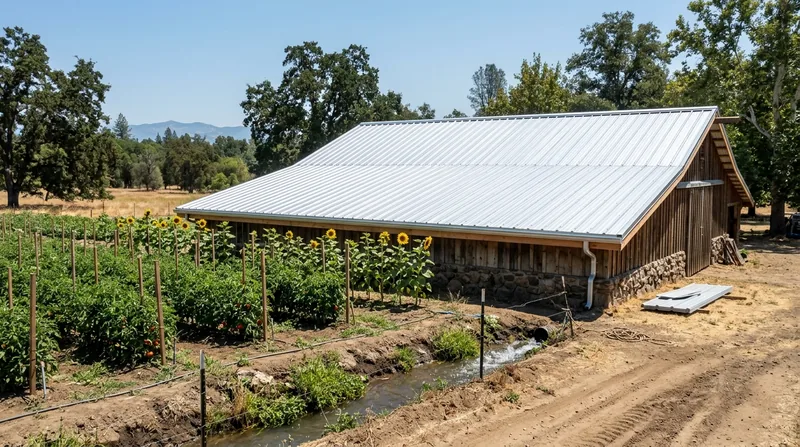




Commercial & Agricultural Metal Roofing in Sacramento
Sacramento sits on the flat valley floor where the Sacramento and American rivers meet, about 30 feet above sea level, with the Sierra foothills rising to the east. That flat ground and the Delta breeze are why the valley has always been farm country, and why so many barns, shops, packing sheds and warehouses around here still wear exposed-fastener metal. Commercial & Agricultural Metal Roofing in Sacramento is a different animal from a house roof: longer runs, fewer penetrations, bigger spans, and panels that have to shed summer heat and winter rain for decades. We install, repair and replace these roofs from the Delta farms out to the shops and warehouses in West Sacramento, Woodland and Galt. If you run a building where the roof is a business asset, not a decoration, we work to that standard. Start with a look at our metal roof installation page for the panel systems we put up.
Why Commercial and Agricultural Metal Roofing Matters in the Sacramento Valley
Summer highs push past 100 degrees for weeks, and the UV here bakes sealants, washers and coatings until they crack. Then the evening Delta breeze and winter storm wind work the fasteners loose, and the first hard rain finds every backed-out screw. On a barn or warehouse with hundreds of linear feet of panel, that is not a cosmetic issue, it is a leak map waiting to happen. Add falling limbs from the valley oaks and sycamores that shade the older properties, and the stakes go up.
- Heat and UV degrade washer seals and coating on exposed-fastener R-panel long before the steel itself fails.
- Thermal movement on long panel runs loosens fasteners and opens laps at the endlap and ridge.
- Storm wind and falling limbs dent panels, shear fasteners and tear flashing at the eaves and gable ends.
- Older building stock from the 1950s to the 1980s often has corrugated panels at the end of their service life.
- Insurance and inspection pressure on commercial buildings makes documented roof condition worth having.
On a working building, a small fastener problem becomes a soaked insulation problem, then a ceiling and inventory problem. Catching it early is the whole game.
Key info: A walnut grower near Winters had a shop roof where the original screws had backed out about an eighth of an inch across two bays. No visible leak yet, but the washers were shot. Re-fastening and replacing the gasketed screws took a day and stopped a much bigger bill.
Roofing permits for commercial and agricultural buildings are issued by the local building department, and requirements vary by jurisdiction, so confirm the rules for your address before any work starts. You can review the City of Sacramento's permit information at cityofsacramento.gov.
How We Approach a Commercial or Ag Metal Roof in Sacramento
We start on the ground with a walkaround and a panel-by-panel look at the fasteners, laps, ridge, and all flashing, because on these roofs the details fail first. Then we get on the roof with the right fall protection and check panel condition, substrate and insulation from above. You get a written scope with photos, not a verbal guess, and we tell you plainly whether repair, re-fastening, coating or full replacement is the honest answer.
- We inspect the roof and document every failed fastener, open lap and damaged panel with photos.
- We check the structure, purlins and insulation to see what the panels are actually sitting on.
- We price repair and replacement side by side so you can see the real numbers.
- We pull the permit where one is required and schedule the inspection.
- We stage materials and equipment so your operation keeps running during the work.
- We install the panels, flashing and closures, then walk the roof and water-test the details.
- We hand over photos and a written summary for your records and your insurer.
That sequence keeps surprises off the invoice and keeps your building usable while we work.
Local example: A church hall in Rancho Cordova had a low-slope R-panel roof with ponding at one corner after storm rain. We traced it to a crushed closure at the eave and a backed-out screw line, not a panel failure. Re-fastening, new closures and fresh sealant fixed it for a fraction of a re-roof. Our screw replacement and re-fastening service covers exactly this kind of job.
Panel Systems and Approaches We Use
Which panel makes sense depends on the building, the span, the budget and whether appearance matters to the owner. A hay barn and a retail warehouse do not need the same roof, and we will say so.
| Approach | Description | Best for |
|---|---|---|
| Exposed-fastener R-panel | Screw-down ribbed panels with gasketed fasteners, fast to install and easy to service. | Barns, shops, sheds and warehouses where budget and speed lead. |
| Standing seam | Concealed-clip panels with raised seams, no through-fasteners on the field of the roof. | Commercial buildings and ag structures that need long service life and clean looks. |
| Panel-over-panel retrofit | New panels installed over an existing metal roof with the right purlin and substrate prep. | Older buildings where the frame is sound and tear-off is not worth the cost. |
| Coating and restoration | Cleaning, re-fastening and elastomeric coating over sound panels. | Roofs that are structurally fine but faded, chalky or leaking at fasteners. |
| Full replacement | Tear-off, substrate repair, new underlayment and new panels with new flashing. | Rusted-through panels, failed substrate or a building changing use. |
We match the panel and the fastening method to the building, not the other way around.
Commercial & Agricultural Metal Roofing Cost in Sacramento: What to Expect
Cost on these roofs is driven by square footage, panel type, how many penetrations and transitions the roof has, and how much substrate repair is hiding underneath. Access matters too: a shop with a clear gravel apron is cheaper to work than a barn hemmed in by equipment and trees. We start every job with a free estimate, then put real numbers on paper after we have seen the roof. For the fuller picture, see our pricing overview.
- Roof size and pitch set the material and labor baseline more than anything else.
- Panel type ranges from exposed-fastener R-panel up to standing seam, and the gap is real.
- Penetrations and flashing at vents, curbs and walls add labor at every one.
- Substrate condition is the wild card: soft purlins or wet insulation change the scope.
- Access and staging for equipment, materials and lifts affect the crew hours.
Get two or three estimates and compare scope line by line, not just the bottom number, because a cheap bid that skips substrate repair is not cheap.
Commercial & Agricultural Metal Roofing Near Me: How to Pick a Contractor Near Sacramento
Anyone can hand you a number. What you want is a contractor who will get on the roof, show you photos, and put the scope in writing. Ask for references on commercial or agricultural buildings similar to yours, not just houses.
- Confirm the contractor is licensed and insured, and ask for the certificate before work starts.
- Get at least two or three written estimates with photos and a clear scope.
- Ask for references on buildings like yours and call them.
- Ask who pulls the permit and who meets the inspector.
- Get the warranty terms in writing, including what voids them.
If a bid is dramatically lower than the rest, ask what it leaves out, because something always is. When you are ready, reach out through our contact page and we will set up a time to look at the roof.
Commercial & Agricultural Metal Roofing in Sacramento: Pricing Guide
| Service | Price | Details |
|---|---|---|
| Roof inspection and written report | Free estimate | On-site look at panels, fasteners and flashing with photos and a written scope, no obligation. |
| Screw replacement and re-fastening | Starting at $450 | Replacing backed-out or failed gasketed screws along identified runs; roof size and access move the number. |
| Exposed-fastener R-panel installation | Starting at $4.50 per sq ft | New ribbed panels, closures and flashing; substrate condition and penetration count are the main cost drivers. |
| Standing seam installation | Starting at $9 per sq ft | Concealed-clip panels with raised seams; building height, pitch and flashing complexity raise the rate. |
| Coating and restoration | On estimate | Cleaning, re-fastening and elastomeric coating; needs an on-site look to confirm panels are sound enough. |
| Travel | Included | In Sacramento and surrounding Valley towns, no separate call-out or mileage fee. |
Indicative pricing, the exact cost depends on square footage, finish, and site access. Free personalized estimate within 24h at (916) 249-2868.


